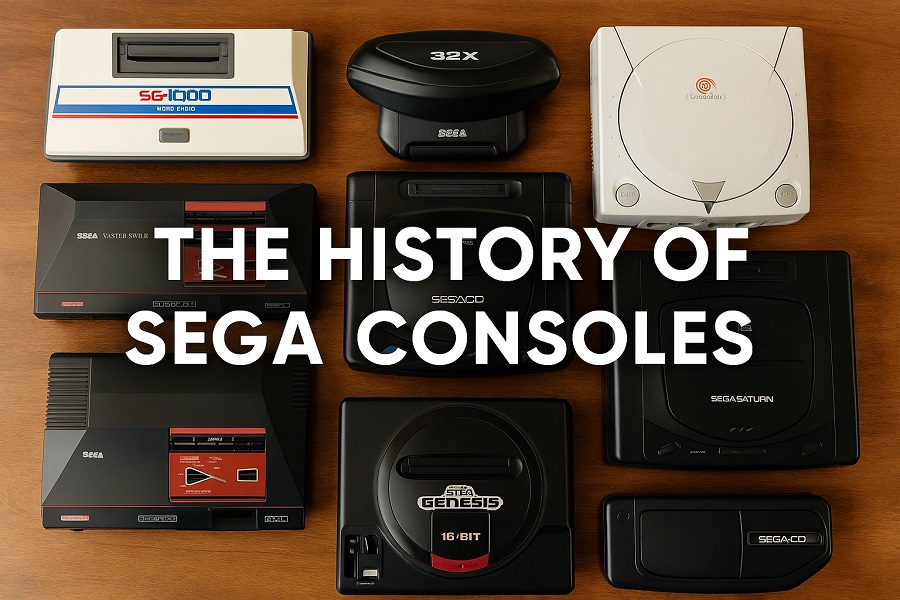
When it comes to retro gaming legends, Sega stands out as a pioneer of bold innovation, unforgettable franchises, and some of the most unique consoles in gaming history. From their modest beginnings with the SG-1000 to the revolutionary Dreamcast, Sega carved out a legacy that continues to influence the industry today.
This article offers a complete history and list of Sega consoles, including detailed insights into each system, sales data, notable games, and the company's impact on the gaming world.
🕹️ Sega Console Timeline Overview
Console
Release Year
Units Sold (Approx.)
Notable Games
SG-1000
1983
1.6 million
Girl's Garden, Champion Boxing
Master System
1985/1986
10 million
Alex Kidd, Phantasy Star
Genesis / Mega Drive
1988/1989
30 million
Sonic the Hedgehog, Streets of Rage
Sega CD
1991
2.2 million
Lunar, Sonic CD
Sega 32X
1994
800,000
Virtua Racing Deluxe, Doom
Sega Saturn
1994
9.3 million
Nights into Dreams, Panzer Dragoon
Dreamcast
1998/1999
9.15 million
Shenmue, Jet Set Radio, Phantasy Star Online
🎮 1. SG-1000 (1983)
Sega’s first step into home gaming launched in Japan on the very same day as Nintendo’s Famicom. Technologically simpler and with limited support, the SG-1000 didn’t dominate, but it was a crucial first chapter.
Key features: 8-bit processor, cartridge-based
Popular titles: Girl's Garden, Champion Boxing
Legacy: Paved the way for Sega's future innovations
🎮 2. Sega Mark III / Master System (1985/1986)
An evolution of the SG-1000, the Master System introduced better graphics and sound. While it struggled in Japan and North America, it gained significant ground in Europe, Brazil, and Australia—thanks to strong support and local licensing.
Key features: Improved VDP chip, card slot
Popular titles: Alex Kidd in Miracle World, Phantasy Star
Legacy: Massive cult following in Brazil (even sold into the 2000s!)
🎮 3. Sega Genesis / Mega Drive (1988/1989)
This 16-bit system marked Sega’s golden era. Known for edgy marketing and iconic mascots like Sonic the Hedgehog, it directly challenged Nintendo and gained a solid foothold in the global market.
Key features: 16-bit graphics, blast processing
Popular titles: Sonic the Hedgehog, Streets of Rage, Altered Beast, Gunstar Heroes
Legacy: First Sega console to outsell a Nintendo system in North America (for a time)
🎮 4. Sega CD (1991)
An ambitious add-on for the Genesis/Mega Drive, the Sega CD aimed to take advantage of the growing CD-ROM trend. It introduced full-motion video games and CD-quality sound—but lacked killer apps to justify the price.
Key features: CD-ROM support, FMV playback
Popular titles: Lunar: The Silver Star, Sonic CD, Night Trap
Legacy: Cult classic status; a bold but flawed attempt at the future
🎮 5. Sega 32X (1994)
Another Genesis add-on, the 32X added 32-bit capabilities but confused consumers already eyeing the Saturn. Poor marketing and limited library led to a quick failure.
Key features: Dual 32-bit SH-2 processors
Popular titles: Doom, Knuckles' Chaotix, Virtua Fighter
Legacy: Often cited as one of Sega's biggest hardware missteps
🎮 6. Sega Saturn (1994)
A powerhouse for 2D games, the Saturn also featured early 3D support—but its complex architecture made development difficult. While it did well in Japan, it struggled elsewhere, partly due to a surprise North American launch and lack of third-party support.
Popular titles: Nights into Dreams, Panzer Dragoon Saga, Virtua Fighter 2
Legacy: Beloved by hardcore fans; critical cult following despite commercial failure
🎮 7. Sega Dreamcast (1998/1999)
Sega’s final console and arguably its most beloved. The Dreamcast was ahead of its time with online functionality, a built-in modem, and games that embraced creativity. Unfortunately, the shadow of the PlayStation 2 was too great.
Key features: Built-in modem, Visual Memory Unit (VMU), GD-ROM
Popular titles: Shenmue, Jet Set Radio, Crazy Taxi, Phantasy Star Online
Legacy: Cult icon; its ideas paved the way for online console gaming
🏁 Why Did Sega Stop Making Consoles?
Despite its innovation, Sega made several costly missteps:
Too many confusing add-ons (Sega CD, 32X)
The Saturn's rushed and chaotic launch
Losing third-party support to Sony and Nintendo
Dreamcast, though excellent, couldn’t survive the PS2 hype
By 2001, Sega officially exited the console business and shifted to becoming a third-party game developer and publisher.
🕹️ Legacy of Sega Consoles
Even though Sega left the hardware market, its influence is everywhere:
Many of its classic IPs—like Sonic, Yakuza, and Persona—are still beloved today
The Sega Genesis Mini and other retro re-releases introduced the consoles to new generations
Collectors and retro enthusiasts hold Sega’s hardware in high regard, especially the Dreamcast
❓ Sega Console FAQ
Q: What was Sega's best-selling console? A: The Sega Genesis/Mega Drive, with approximately 30 million units sold globally. Q: Why did the Sega Dreamcast fail? A: Despite innovation, it was outpaced by the PlayStation 2's marketing, third-party support, and DVD playback capabilities. Q: Which Sega console introduced Sonic the Hedgehog? A: The Sega Genesis (aka Mega Drive) in 1991. Q: Is Sega still making consoles? A: No. Sega stopped producing consoles after the Dreamcast and now focuses on games and publishing. Q: Are any Sega consoles still sold today? A: While new consoles aren't made, mini retro systems like the Genesis Mini are available.
💬 Conclusion: A Legacy of Innovation and Risk
From the humble SG-1000 to the visionary Dreamcast, Sega's history in console development is a story of bold moves, creative risks, and unforgettable gaming moments. While not every console was a commercial success, each left a lasting mark on the gaming industry.
This complete history and list of Sega consoles reminds us that innovation doesn't always win in the short term—but it does create legends.